

Industry · Government
Operational intelligence for the State.
For national and regional governments that must run public policy, citizen security and crisis management with data scattered across many agencies.
The problem · Government
Four agencies get the same alert and none coordinates the response.
- 01Fragmentation
Each ministry has its own system — coordination happens by meeting, not by data.
- 02Manual triage
Citizen service is saturated and scattered across channels that don't learn from one another.
- 03Late decisions
Social crises are detected on social media but the institutional response arrives after they go viral.
70%
of the cost of a critical incident builds up in the first 2 hours.
62%
of operational time is spent querying systems before being able to decide.
9×
more correlated events are detected when data is cross-referenced in real time.
Estimates based on incident-response benchmarks · Internal analysis 2025–2026
State agencies have the data. What they lack is the layer that connects it. Naboo cross-references social, cadastral, tax, judicial, health and security data under local sovereignty. It anticipates social crises and coordinates the response without removing data from any agency.
Naboo · in Government
How it works in your operation.
State agencies have the data. What they lack is the layer that connects it. Naboo cross-references social, cadastral, tax, judicial, health and security data under local sovereignty. It anticipates social crises and coordinates the response without removing data from any agency.
- Early detection of social tension and disinformation
- Inter-agency coordination during crises and emergencies
- Mass citizen service through agents
- Financial intelligence against the illicit economy
naboo://centinela
liveOperational map · live
KPI · shift
MTTA
2.4m
Coord.
−65%
Events
142
SLA
98%
Alerts · 3 active
EV-082
NE sector
EV-079
SE-04
EV-077
Citizen
Case · anonymized
What changed once it was integrated.
Context
Regional government with 9 ministries and a newly created emergency coordination center.
Process
Deployment of Centinela as a command layer + Inbox unifying security, health, mobility and social signals.
Result
58% reduction in inter-agency coordination time during a 72-hour protest episode.
Reference KPI
What moves.
01
−65%
Inter-agency response time
Measured in emergency-response drills with cross-ministry coordination, compared against the prior flow based on calls and memos.
02
Federated data
Without removing information from any agency
The architecture runs inference locally at each agency and only exchanges signed results.
03
100% audit
Every decision traceable and signed
Every query and recommendation is logged by Escudo with identity and timestamp.
How it's composed
The modules for your operation.
Modules involved

Halcón
Observes signals and territory
Satellite, radar, sensor and social signals on a single screen. What you normally wouldn't see in time.

Inbox
Unifies the data
A single inbox for every signal, normalized and with its origin.

Oráculo
Predicts and simulates
Anticipates what's about to happen and shows what breaks if it does.
Centinela
Coordinates the operation
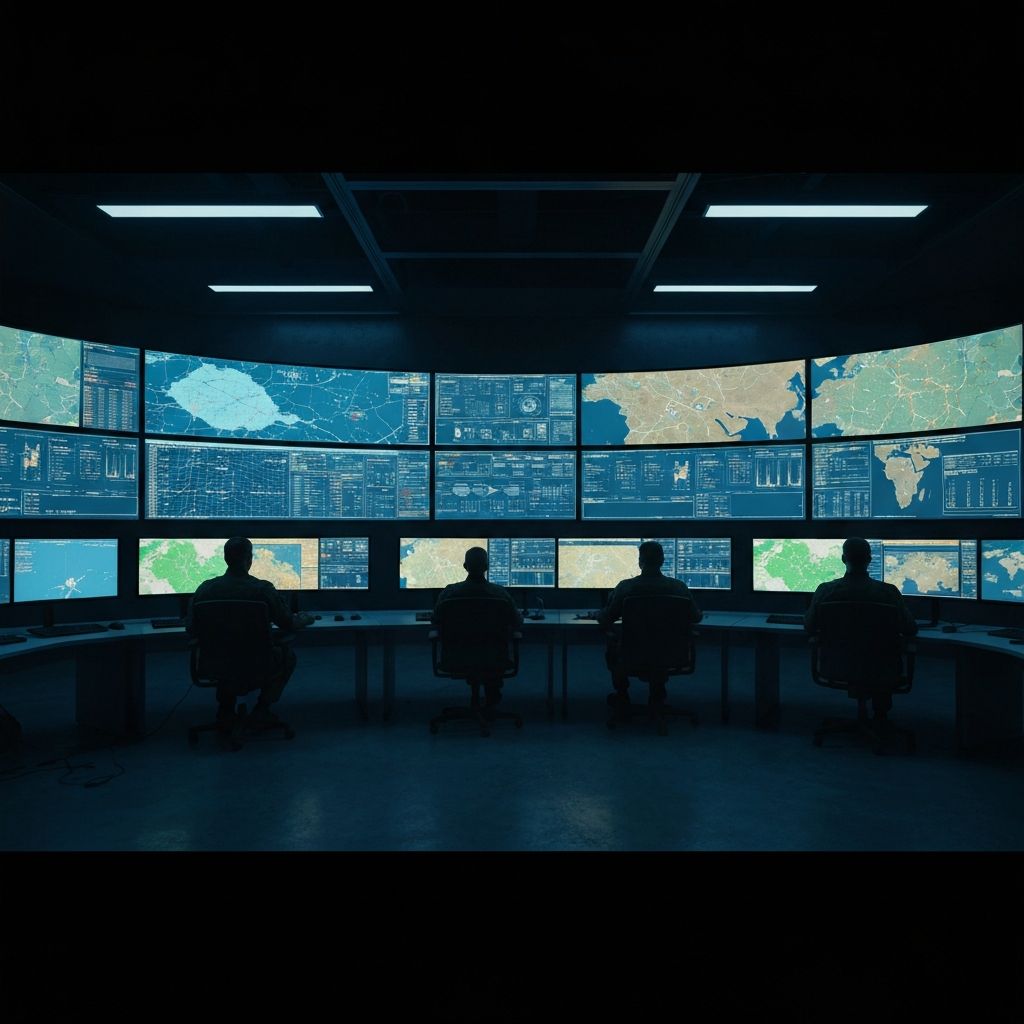
The command center where your team sees the operation, decides and coordinates the response.

Genius
Executes via agents
Agents that execute at scale what the team decided. Messages, calls and reports.
Escudo
Sustains continuity
Sovereignty and signed audit. On-prem, edge or air-gapped deployment.
Applicable solutions
Next step
Demo for Government.
Government demo: 45 min with an inter-agency operational case.